Showing posts with label White (without gills). Show all posts

Wednesday, 27 April 2011

#52 Battarrea stevenii

My first sighting of this fungus was filled with excitement and anticipation - had I found my first Tall Stiltball?  If so, why was the cap so odd, and where were the spores?  I solved the puzzle with the help of a fellow fungi enthusiast, and was over the moon to find another specimen with dome-shaped spore mass intact.

Battarrea stevenii [pronunciation: Bat-ta-rhea steven-ee-eye] is commonly called Tall Stiltball, for obvious reasons; when intact, it resembles a ball on top of a stilt. It is a stalked puffball.

Unfortunately I have not yet observed a fresh specimen.  The fruit body emerges from a round or oval egg-like structure up to 50mm in diameter, partly covered in sand.  This 'egg' splits to form a non-gelatinous volva (a volva is typically a cup-like structure at the base of fungus fruit body stem).  The stem then emerges from the volva and grows, with the top of the 'egg' remaining on top of the stem, forming a cap or cover for the spore mass.  This cap will often be encrusted with sand.  In time, this cover will fall off exposing the spore mass.

The dry, scaly, woody stem can be up to 350mm high and 15mm diameter. The outer layer of the head of the fruiting body flakes off, and the inner layer falls away as one piece, to reveal a rusty-brown powdery dome of spores on top of disc-shaped apex of stem.

Battarrea stevenii is a dry country fungus, growing singly or in pairs on sandy soil with leaf litter.  It is a saprotrophic species (obtains nutrients from dead and decaying organic matter).

According to FungiMap, Battarrea stevenii is found in dry, semi-arid and  desert regions throughout Australia.  It is also found throughout North America, primarily in western regions; South America, Africa, Europe, and China.

Battarrea stevenii is inedible. 

Scaly stem, disc-shaped apex of stem, spores dispersed
Stem dry and woody, somewhat resembling Stringy-bark Eucalypt texture

Notice rusty coloured spores on the stem and ground

The three components: cap (cover of spore mass), spore mass, and stem

The underside of the cap that covered the spore mass

The top side of the cap (spores on my thumb)

Habitat of Battarrea stevenii - dry open woodland with leaf litter

My sightings of Battarrea stevenii

[This will be updated with new sightings]

Gibson Way through Macquarie Marshes, NW NSW - Jul 2010, Aug 2010

Nymagee, Western NSW - Sept 2012

A very tall specimen

Saturday, 19 February 2011

#50 Podaxis pistillaris

I think it's appropriate that the 50th fungus that I post to my blog be a semi-arid area species, as I've taken such an interest in nature of the dry northwest country of New South Wales.  Contrary to my initial assumption that fungi would be few and far between in the sand of the inland, I've discovered some extraordinary fungi as well as flushes of a wide variety of species after soaking rains.

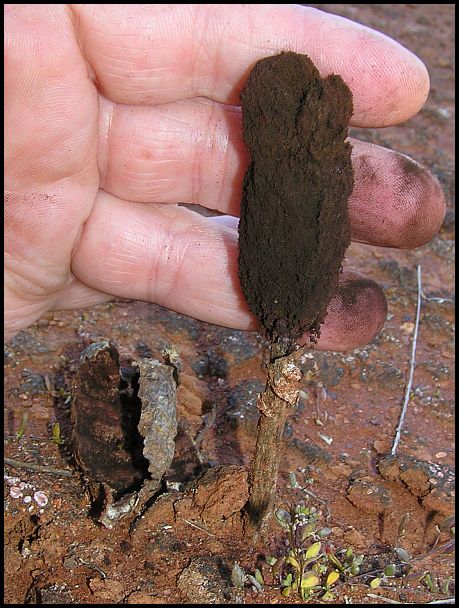
Podaxis pistillaris is one such strange fungus of arid and semi-arid areas.  Pronunciation is Pod-axis piss-till-are-iss, and its common name is Black Powderpuff.


This stalked puffball is reported to be reasonably common under the right conditions, but I've only been lucky enough to find one outbreak.

The club-shaped cap on rigid woody stem can reach a total height of about 200mm.  Fresh specimens have caps covered by a white skin that ages to patchy or scaly dirty white, to eventually become wrinkled.  Matured cap skin then cracks and falls off in flakes or pieces, revealing a dark brown spongy spore mass.

The dense, dry, powdery gleba is not a tightly packed mass that ends up falling apart quickly when exposed to the elements of wind, rain and animal movement.  When I touched one, it was obvious it had a fine knitted texture like sheer panty-hose stretch silk fabric, and when picked at, released dark brown (almost black) spores in powdery puffs.  This feature, combined with a sturdy fibrous stem extending into the gleba, means the fungus persists under whatever climatic conditions are dished up, allowing the spores to be distributed over time.

Podaxis pistillaris inhabits open situations growing singly or in groups in sandy or clay soils, and is saprotrophic (obtains nutrients from dead or decaying organic matter).

Fungimap Australia has recorded Podaxis pistillaris throughout inland Australia, but not Tasmania. It is also found in Africa and South Africa, Afghanistan, Brazil, USA, Pakistan, Iran, and other countries with semi-arid or desert eco-systems.  It has not been found in Japan or Europe.


My sightings of Podaxis pistillaris
[This will be updated with new sightings]

Cobar, NSW - sand and clay bush tracks and roadsides after rain, Sept 2010.

*****  *****  *****

Uses for Podaxis pistillaris:  The fruiting bodies of P. pistillaris are used in some parts of Yemen for the treatment of skin diseases, in South Africa as folk medicine against sunburn. In other countries, e.g. India, Afghanistan and Saudi Arabia, they are used as food.

Preliminary experiments have been conducted on the artificial cultivation of Desert mushroom (or Black Powderpuff), Podaxis pistillaris, at Sindh Agriculture University Tandojam. The results reveal that it can also be easily grown as that of other cultivated mushrooms with a little difference.

In Australia, the fungus was historically used by Aborigines to darken the white hair in the whiskers of old men, for body painting and as a fly repellent.

Medicinal properties:  Podaxis pistillaris have been reported to be used in China to treat inflammation but there doesn't appear to be any scientific evidence that might support this usage. Water extracts from the mushroom have apparently been shown to have carbohydrates with beneficial effects on the immune system in vitro. [Some reading here]

Monday, 29 June 2009

#32 Ileodictyon gracile

Ileodictyon gracile (Smooth Cage) is a stinkhorn fungus. There is nothing horn-like in the appearance of this fascinating fungus, rather, it resembles a lattice structure, and is therefore sometimes referred to as Lattice or Basket Stinkhorn Fungus.

With a gentle nudge with the boot, this fungus sprung from its outer skin with the speed and surprise of a Jack-in-the-box - it was an exciting spectacle. I nudged others, but they obviously were not mature, and did not spring open.

An intact Illeodictyon gracile (Smooth Cage)
is made up of polygons resembling a hollow soccer ball


I have had a marvellous time observing these fungi in my garden following recent rain. As soon as I discovered the 'eggs' amongst fallen autumn leaves on my lawn, and felt their rubbery texture, I realised they were a stinkhorn fungus of some sort.

Habitat of Ileodictyon gracile includes mulch and woodchips, on the ground and leaf litter in gardens or on edges of tracks, and in native forests in southern Australia. It grows singly or in groups, and according to Fungimap Australia, is common and widespread.

An 'egg' (unopened sac) of Ileodictyon gracile
- off-white in colour and up to 40mm diameter


A dissected young 'egg' of Ileodictyon gracile


The flat arms broaden out where they join, distinguishing this fungus from the similar Ileodictyon cibarium (Crinkled Cage). The fruit body can apparently be up to 300mm in diameter, with up to 30 meshes formed by a spherical network of linked arms. The cage can become free from the remains of the casing and roll freely along the ground. The width of the arms is up to 5mm.

I unintentionally ran over this stinkhorn egg with
the mower, exposing the folded 'arms'

The spore mass (gleba) is brown and slimy, and forms on the inside of the arms. It smells sour, but not fetid like some other stinkhorn species.

Notice the widening of the arms where they join (an identifying feature). Also notice the remains of the outer skin ('egg') of the fungus on the right. This stinkhorn has been damaged by slugs and rain.


Ileodictyon gracile is reported to be native to Australia, New Zealand, and Chile, and has been introduced in East Africa and Europe.

My sightings of Ileodictyon gracile
[This will be updated with fresh observations]

Singleton (Hunter Valley, NSW) - Urban, on ground under deciduous tree - Jun 2009, Jul 2010, Jul 2011

Jesmond (Hunter Valley, NSW) - Parkland, on woodchipped garden - Jun 2009

Below is a series of photos showing interesting characteristics. An egg of Ileodictyon gracile in my lawn has been invaded by slugs - note, in this image, the slug has its head buried in the fungus . . . . .

. . . . . as slugs have been feeding on this fungus for a week, I presumed the stinkhorn would not reach maturity intact, so I picked it to examine it - note the conical shape . . . . .


. . . . . I carefully peeled the outer skin from the fungus, leaving a solid structure with the feel and consistency of hardened gelatine. When I pulled the outer pieces from the stinkhorn, the imprint of the lattice arms was left (the dark speckles are dirt) . . . . .


. . . . . the Smooth Cage was compacted like tough rubber, and could not be separated without breakage - I presume that as air had reached the fungus via the hole the slugs were feeding through, the fungus has hardened. Note, the brown substance adhered to the inside of the arms is the gleba (spore mass), which had also hardened.

Tuesday, 25 September 2007

#26 Laetiporus portentosus


The polypore fungus, Laetiporus portentosus, commonly called White Punk, forms large, thick brackets on living Eucalypts. It causes white heart-rot to the host tree. I have seen it adhered to both smooth and rough-barked Eucalypts.

Brackets can reportedly reach 350mm wide, but I have only seen them to about 150mm wide. The upper surface of the fungus has a slightly 'velvety' texture and can be off-white, beige, to a warm 'biscuit' brown colour.

Notice the pock-marked under-surface which is riddled with tiny larvae


The fertile under-surface is covered in very fine pores, and is pale yellow or white when fresh, aging to a dirty white. Certain insect larvae feed on the soft flesh of the White Punk fungus creating a maze of tunnels with the old fruiting body of the fungus resembling a sponge in appearance.

When I first saw the soft white spongy structure attached to the trunk of a eucalyptus tree, I questioned if it could be a lichen. The old grey fruit bodies riddled with tunnels will eventually fall from the tree, sometimes following rain when it would collect water and become heavy.

A close-up of the fine pore surface. I will replace this unsharp image with a clear one if I can get one. The White Punk fungi are often high on tree trunks making close-up images difficult to obtain.

Dry, smouldering brackets were reportedly used by Aborigines to transport fire. Aborigines had many uses for various fungi. Spore print is white, although I have not attempted to obtain a print.

Although my images do not portray an attractive fungus, I have seen images of new Laetiporus portentosus fungi that show a smooth, quite aesthetically pleasing cluster.


White Punk riddled with tunnels and holes


A close up of the soft-textured well-eaten White Punk


As the decayed fungus fruiting body ages further, it can become quite hard and brittle


My sightings of Laetiporus portentosus

[This will be updated with more sightings]

Hunter Valley, NSW - on scattered roadside Eucalypts - May, Jun.

Grampians National Park, Vic - on scattered roadside Eucalypts - Sep.

Weetabilla, NSW - on scattered roadside Eucalypts - Jul.

Tuesday, 15 May 2007

#13 Calvatia cyathiformis


Calvatia cyathiformis, commonly called the Purple-spored Puffball, is from family Lycoperdaceae. It is a terrestrial puffball, relatively smooth and spherical or slightly flattened when young, often becoming pear-shaped or irregularly shaped as it matures.

It can be distinguished from other large Lycoperdales by its purple-brown spores. This puffball is reported to be edible when the gleba (spore bearing interior) is immature and white with the consistency of firm marshmallows.

The cracked exterior layer sheds to reveal spores


The skin of the fungus dries and darkens, and cracks with age, sometimes resembling a tesselated pattern (as shown in the previous image). The fleshy spore-bearing mass begins to turn purple-brown, breaks away and is distributed by wind and rain.

When the spores are completely dispersed, a soft leathery cup-shaped sterile base lightly rooted to the ground remains.

I have closely observed the growth and breakdown of a Purple-spored Puffball growing in a grazing paddock. These details can be veiwed at my Nature Blog.

The purple-brown spore mass is exposed

This is a common puffball in grazing paddocks and grassed areas in the Hunter Valley rural district in which I live. I am unaware, at this time, of its complete distribution.

This specimen has a stout base resembling a stalk


My sightings of Calvatia cyathiformis

[This will be updated with future sightings]

Hunter Valley, NSW - unimproved grazing paddocks: Nov, Dec, Jan.

Merriwindi State Conservation Area - (Baradine, NW NSW) - compacted sandy soil: Jun, Jul.

Macquarie Marshes district (NW NSW) - grazing paddock following rain: Jul.


Irregular shapes of Calvatia cyathisformis