The Hunter Valley has received light showers of rain recently (as has many other parts of eastern Australia), hence the time is right for fungi.
Cordyceps gunnii (Dark Vegetable Caterpillar) is an intriguing fungus. Cordyceps are parasitic fungi, but rather than choose a plant as a host like many other parasitic fungi, they attack insect larvae.
The mycelium (underground mass of microscopic fungi filaments called hyphae) of cordyceps gunnii invades a moth larva, feeding on it and eventually replacing the host tissue. An elongated fruiting body is then sent to the surface to distribute spores to aid in the spreading of the fungus.
Cordyceps gunnii (Dark Vegetable Caterpillar) is an intriguing fungus. Cordyceps are parasitic fungi, but rather than choose a plant as a host like many other parasitic fungi, they attack insect larvae.
The mycelium (underground mass of microscopic fungi filaments called hyphae) of cordyceps gunnii invades a moth larva, feeding on it and eventually replacing the host tissue. An elongated fruiting body is then sent to the surface to distribute spores to aid in the spreading of the fungus.
Cordyceps gunnii fruiting bodies
Werekata National Park, Cessnock, NSW
Werekata National Park, Cessnock, NSW
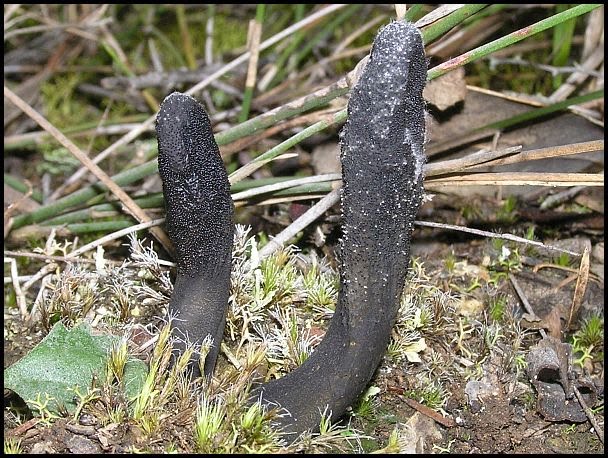
The black club-like or finger-like Cordyceps gunnii fungus fruit-bodies usually appear under mature wattles. The habitat of the examples featured here was Eucalypt, Leptospermum and Acacia woodland. Fruit-bodies have a height of up to 120mm above the ground, are dark olive-green to black in colour, are cylindrical or flattened with a blunt end. The smooth surface is covered in minute dots (ostioles), from which white spores emerge.
The head merges smoothly into a stem - this is an identifying feature, separating it from other dark club-like fungi. The white to pale yellow underground stem can reach 400mm, depending on the depth of the moth larva it has parasitised.
Cordyceps gunnii grows singly or in groups, and is known to be common. I found a colony of more than 20 fruiting bodies after rain.
The head merges smoothly into a stem - this is an identifying feature, separating it from other dark club-like fungi. The white to pale yellow underground stem can reach 400mm, depending on the depth of the moth larva it has parasitised.
Cordyceps gunnii grows singly or in groups, and is known to be common. I found a colony of more than 20 fruiting bodies after rain.
A copious amount of white spores surrounds
this Cordyceps fruit-body
this Cordyceps fruit-body

Notice the smooth transition from head to stalk.
My hand gives a size comparison.
My hand gives a size comparison.

The tiny 'dots' on the head are openings for spores
to emerge from the mature fruiting body
to emerge from the mature fruiting body

This Cordyceps fruit-body is coated in white spores

A flattened, rather than the usual cylindrical fruit-body

If a caterpillar larva is especially rich in nutrients
two clubs of the Dark Vegetable Caterpillar may emerge
two clubs of the Dark Vegetable Caterpillar may emerge

I managed to extract the full stem of this Cordyceps

My sightings of Cordyceps gunnii
[This will be updated with new sightings]
[This will be updated with new sightings]
Werekata NP, Cessnock, NSW - Eucalypt, Leptospermum and Acacia woodland - Jul
New England NP, NSW - Native forest - May.
New England NP, NSW - Native forest - May.


