I think it's appropriate that the 50th fungus that I post to my blog be a semi-arid area species, as I've taken such an interest in nature of the dry northwest country of New South Wales. Contrary to my initial assumption that fungi would be few and far between in the sand of the inland, I've discovered some extraordinary fungi as well as flushes of a wide variety of species after soaking rains.
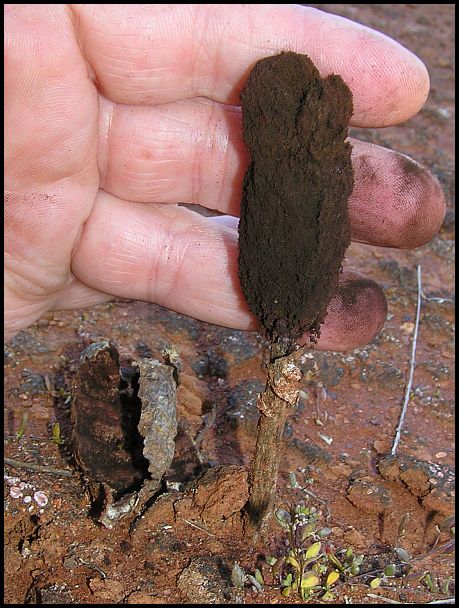
Podaxis pistillaris is one such strange fungus of arid and semi-arid areas. Pronunciation is Pod-axis piss-till-are-iss, and its common name is Black Powderpuff.

This stalked puffball is reported to be reasonably common under the right conditions, but I've only been lucky enough to find one outbreak.
The club-shaped cap on rigid woody stem can reach a total height of about 200mm. Fresh specimens have caps covered by a white skin that ages to patchy or scaly dirty white, to eventually become wrinkled. Matured cap skin then cracks and falls off in flakes or pieces, revealing a dark brown spongy spore mass.
The dense, dry, powdery gleba is not a tightly packed mass that ends up falling apart quickly when exposed to the elements of wind, rain and animal movement. When I touched one, it was obvious it had a fine knitted texture like sheer panty-hose stretch silk fabric, and when picked at, released dark brown (almost black) spores in powdery puffs. This feature, combined with a sturdy fibrous stem extending into the gleba, means the fungus persists under whatever climatic conditions are dished up, allowing the spores to be distributed over time.
Podaxis pistillaris inhabits open situations growing singly or in groups in sandy or clay soils, and is saprotrophic (obtains nutrients from dead or decaying organic matter).
Fungimap Australia has recorded Podaxis pistillaris throughout inland Australia, but not Tasmania. It is also found in Africa and South Africa, Afghanistan, Brazil, USA, Pakistan, Iran, and other countries with semi-arid or desert eco-systems. It has not been found in Japan or Europe.



My sightings of Podaxis pistillaris
[This will be updated with new sightings]
Cobar, NSW - sand and clay bush tracks and roadsides after rain, Sept 2010.
***** ***** *****
Uses for Podaxis pistillaris: The fruiting bodies of P. pistillaris are used in some parts of Yemen for the treatment of skin diseases, in South Africa as folk medicine against sunburn. In other countries, e.g. India, Afghanistan and Saudi Arabia, they are used as food.
Preliminary experiments have been conducted on the artificial cultivation of Desert mushroom (or Black Powderpuff), Podaxis pistillaris, at Sindh Agriculture University Tandojam. The results reveal that it can also be easily grown as that of other cultivated mushrooms with a little difference.
In Australia, the fungus was historically used by Aborigines to darken the white hair in the whiskers of old men, for body painting and as a fly repellent.
Medicinal properties: Podaxis pistillaris have been reported to be used in China to treat inflammation but there doesn't appear to be any scientific evidence that might support this usage. Water extracts from the mushroom have apparently been shown to have carbohydrates with beneficial effects on the immune system in vitro. [Some reading here]
