A blue mushroom - beautiful! Blue is not a common colour amongst fungi, but the Cortinariaceae family features a few blueish species.
Cortinarius rotundisporus - Elegant Blue Webcap

Cortinarius rotundisporus (pronunciation: Court-in-air-ee-us row-tun-dee-spore-uss), has the very appropriate common name of Elegant Blue Webcab. The 'webcap' refers to the cortina, which is a partial veil consisting of a cobweb-like protective covering over the immature spore-bearing surface. Cortinas typically disintegrate as the mushroom matures, disappearing entirely, or leaving a ring-zone on the stem.
The cap can grow to 70mm diameter, convex at first, flattening out, often turning up with age. It is a deep indigo blue, paling with age, eventually becoming a rusty-brown tinged with blue. At first, the cap is viscid (slimy), but dries with age. A broad greenish-yellow umbo (central swelling or 'bump') is usually present in mature specimens.
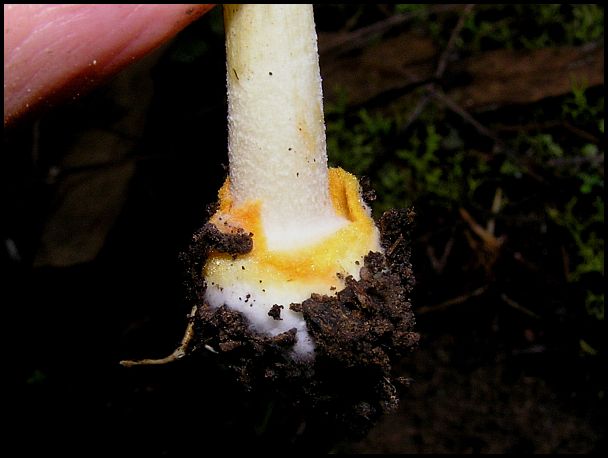
Gills are close together and of various lengths; pale lavender tinged with buff in young specimens, maturing to a rusty-brown. The stem is usually slender and can reach a height of 140mm with a diameter up to 20mm; bluish at the top, and white to yellow at the base; and can be slimy when young. Spore print is rusty-brown.
Cortinarius rotundisporus is reportedly a common species found singly or in groups on the ground in Eucalypt forests and woodlands in temperate Australia.
[Ref: "Fungi Down Under - the Fungimap Guide to Australian Fungi"]
***** ***** *****
The cap can grow to 70mm diameter, convex at first, flattening out, often turning up with age. It is a deep indigo blue, paling with age, eventually becoming a rusty-brown tinged with blue. At first, the cap is viscid (slimy), but dries with age. A broad greenish-yellow umbo (central swelling or 'bump') is usually present in mature specimens.
Gills are close together and of various lengths; pale lavender tinged with buff in young specimens, maturing to a rusty-brown. The stem is usually slender and can reach a height of 140mm with a diameter up to 20mm; bluish at the top, and white to yellow at the base; and can be slimy when young. Spore print is rusty-brown.
Cortinarius rotundisporus is reportedly a common species found singly or in groups on the ground in Eucalypt forests and woodlands in temperate Australia.
[Ref: "Fungi Down Under - the Fungimap Guide to Australian Fungi"]
A tiny convex fresh specimen with a maturing one

Caps expanding from convex through to flattening.
Note the yellowish umbo on the right-hand cap.
Note the yellowish umbo on the right-hand cap.

Caps flattening out - note rusty-brown spores
on stem, and cap of smaller fungus.
on stem, and cap of smaller fungus.

And the cap sometimes eventually turns up.

The cap turns a rusty-brown with age.
Note Aleurina ferruginea in the left of image.
Note Aleurina ferruginea in the left of image.

Pale gills on a young fruit body. . . . .

. . . . .turning a slightly darker shade of lavender
tinged with buff. . . . .
tinged with buff. . . . .

. . . . .finally turning a rusty shade of brown.

My sightings of Cortinarius rotundisporus
[This will be updated with new sightings]
Brunkerville, NSW - Native forest, Jul 2010, May 2011, Jun 2011.
New England NP, NSW - Native forest, May.